The second, more substantive book
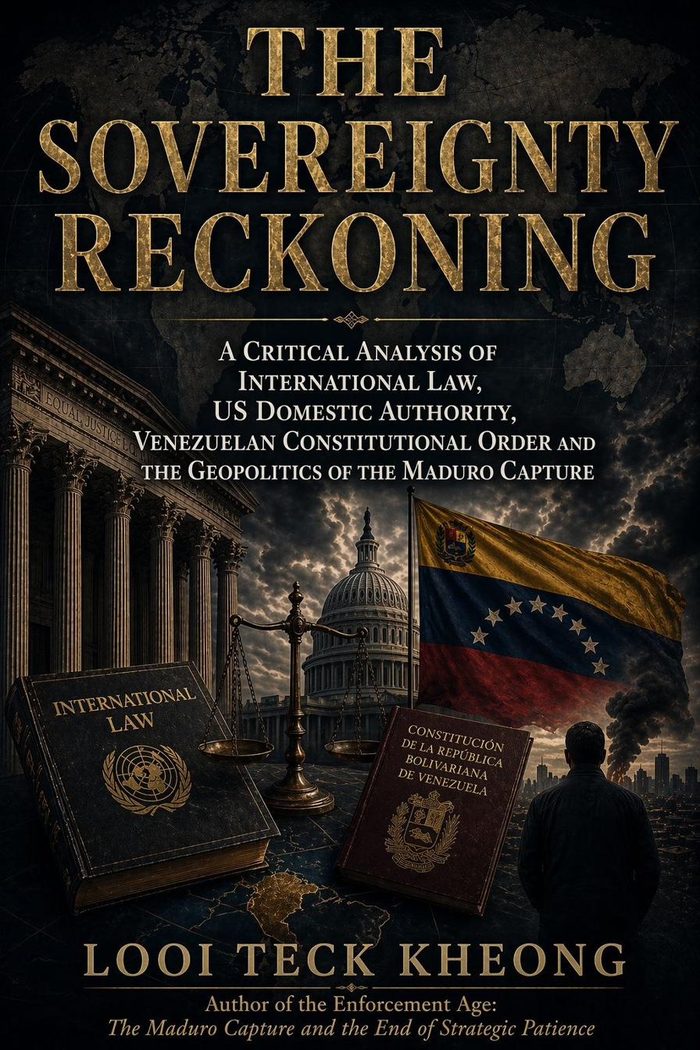
The Sovereignty Reckoning
A Critical Analysis of International Law, US Domestic Authority, Venezuelan Constitutional Order and the Geopolitics of the Maduro Capture
The capture of a sitting head of state, in his own capital, by military force, under a domestic indictment, framed as law enforcement. This book asks what that combination means for international law, and gives honest answers.
Bibliographic recordBook II
- Author
- Looi Teck Kheong
- Published
- 2026, completed March 2026
- Format
- Paperback
- ISBN
- 9789819462407
- Length
- About 380 pages
§ 01The argument
Two findings, both true at once
The book states its central conclusion at the outset: the operation most probably violated international law as it stands today, while remaining legally defensible under US domestic law as it stands today. Neither finding cancels the other. The tension between them is a feature of the international legal architecture that has to be acknowledged and managed.
It takes positions. It identifies violations where the law supports that conclusion, declines to treat the enforcement exception as settled custom merely because the operation succeeded, and declines to dismiss the Global South’s objections or Venezuela’s suffering as legally irrelevant.
Then it does what practitioners need: it proposes how the law should develop, through the Five Threshold Conditions Framework, a Three-Track Resolution Framework for immunity and accountability, a multilateral assessment mechanism, and ten forward reforms. These are offered openly as proposals for the law to come, not descriptions of existing law.
This book is not a verdict. It is an attempt to understand, with the rigour that the event demands and the honesty that it requires, what January 3, 2026 means for international law.From the Prologue
§ 02The method
The four legal orders
The book’s method treats four bodies of law as equal lenses. Each gives a different answer to the same questions, and the book explains why each remains plausible.
Public international law
The UN Charter’s prohibition on the use of force, head of state immunity, and the work of the ICJ and ICC.
United States federal law
War powers, sanctions, statutory jurisdiction and the Ker-Frisbie doctrine that lets US courts try defendants brought before them by force.
Venezuelan constitutional and criminal law
Presidential legitimacy, succession, and the collapse of domestic accountability.
The NSS 2026 political-security doctrine
The hemispheric dominance doctrine and the strategic interests that shaped the operation.
§ 03The proposal
The Five Threshold Conditions
The book’s main normative contribution is a structured test for when an enforcement operation against a state’s leadership could be considered legitimate. Each condition comes with a falsification standard: an account of the evidence that would show it is not met.
Appendix A provides an assessment template so readers can apply the framework to other cases themselves.
Directional integration
Is the state’s leadership itself directing criminal enterprise, shown by independent evidence?
Institutional instrumentalisation
Have state institutions been turned into tools of that enterprise?
Transnational harm of scale
Does the harm extend across borders at a significant and documented scale?
Exhaustion of alternatives
Have extradition, sanctions, diplomacy and other lawful routes genuinely been tried and failed?
Proportionality and post-action responsibility
Is the operation proportionate, and does the acting state accept responsibility for what follows?
§ 04In the classroom
Built for teaching and practice
Every chapter closes with a case problem set in a fictional jurisdiction: a fact pattern, a set of questions, and a model analysis applying the chapter’s principles. Fourteen problems in all, indexed and cross-referenced in Appendix E.
That makes the book useful for law school seminars in public international law, moot court preparation, and briefing sessions for government lawyers and institutional advisers.
Written for
International lawyers and arbitration practitioners, judges and government legal advisers, scholars and students of international law and international relations, and anyone advising states or organisations exposed to the new enforcement precedent.
All case studies and scenarios in the book are fictional and used to clarify legal principles. The book is analysis, not legal advice.
§ 05Table of contents
Contents
Fourteen chapters, an epilogue and five appendices.
The legal architecture
- Ch. 1Four Legal Orders Simultaneously in Play: Mapping the Jurisdictional Architecture of the Maduro Capture
- Ch. 2The Narco-State Threshold in International Legal Theory: Conditional Sovereignty, Criminalized Governance, and the Venezuelan Case
- Ch. 3Use of Force, Extraterritorial Jurisdiction, and the Ker-Frisbie Doctrine: Article 2(4) and Its Limits in the Enforcement Age
- Ch. 4Head of State Immunity: The Customary Rule, Its Erosion, and the Immunity-Accountability Paradox
Domestic orders and strategy
- Ch. 5United States Domestic Legal Authority: War Powers, the Sanctions Architecture, Statutory Jurisdiction, and the Constitutional Framework for Operation Absolute Resolve
- Ch. 6Venezuelan Constitutional and Criminal Law: Presidential Legitimacy, Succession, Domestic Accountability, and the Institutional Collapse of the Rule of Law
- Ch. 7Trump’s NSS 2026, Hemispheric Dominance Doctrine, the Energy War, and the Geopolitics of Enforcement
- Ch. 8The War Against the Cartels: Narco-Terrorism Law, Drug Trafficking Statutes, and the Evidentiary Architecture of the Maduro Prosecution
Toward new norms
- Ch. 9The Enforcement Age and the Future of International Order: The Five Threshold Conditions for Legitimate Enforcement
- Ch. 10Toward a Legal Doctrine of Conditional Sovereignty: State Practice, Opinio Juris, and the Architecture of Accountability
The world’s response and what follows
- Ch. 11The Great Power Recalibration: China, Russia, and the Strategic Shock of the Enforcement Precedent
- Ch. 12Regional Recalibration: Latin America, the Caribbean, ASEAN, MERCOSUR, the African Union, and the Global South Response
- Ch. 13What Comes Next: War, Law, and Order Rewritten
- Ch. 14The Sovereignty Reckoning: Law, Power, Accountability, and the Human Stakes
- Epilogue
Appendices
- App. AThe Five Threshold Conditions Assessment Template
- App. BFive Threshold Conditions: Venezuela compared with a hypothetical case
- App. CState-Crime Integration Spectrum: matrix of all assessed cases
- App. DChronological Timeline: the Maduro capture and key legal events, 2020 to 2026
- App. EThe Fourteen Case Problems: index and cross-reference guide
§ 06Availability
Where to buy The Sovereignty Reckoning
Fourteen bookstores across six continents. Search ISBN 9789819462407 at your local bookshop if it is not listed here.
United States and Australia
Not listed in your country? Any bookshop can order it by ISBN.
Cite this book
Looi Teck Kheong. 2026. The Sovereignty Reckoning: A Critical Analysis of International Law, US Domestic Authority, Venezuelan Constitutional Order and the Geopolitics of the Maduro Capture. Paperback. ISBN 9789819462407.
Book I
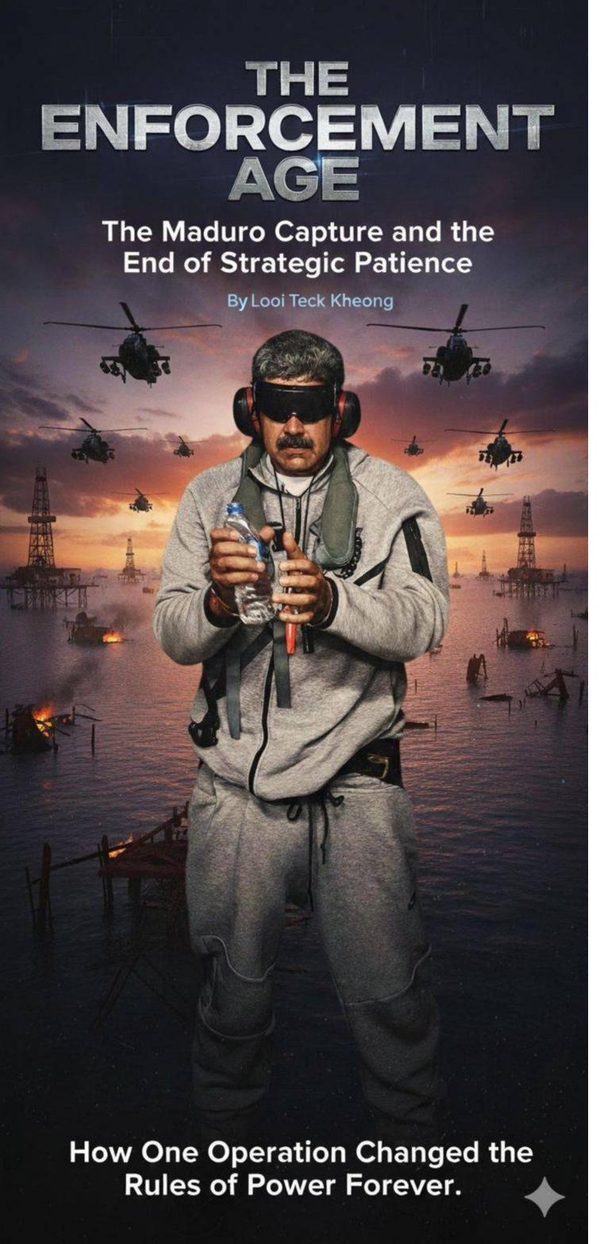
Start with the first account
The Enforcement Age, written within days of the operation, is the strategic orientation from which this book’s legal analysis grew. It reads quickly and sets the scene.